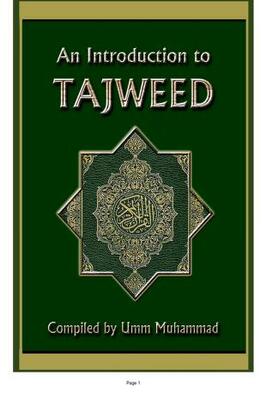
| Book Title | An Introduction To Tajweed |
| Book Author | Umm Muhammad |
| Total Pages | 57 |
| Book Views |
|
| Language | English |
| Book Download | PDF Direct Download Link |
| Get Hardcover | Click for Hard Similar Copy from Amazon |

An Introduction to TAJWEED
AN INTRODUCTION TO TAJWEED
An Introduction to TAJWEED
مختصر أحكام التجويد
Compiled by Umm Muhammad
This book has been produced in collaboration with saheeh international”
“Whoever recites the Qur’an being skillful in it will be with the honorable messenger-angels. And whoever recites the Qur’an with hesitation as it is difficult for him will have a double reward.” (A hadith narrated by al-Bukhari, Muslim, at-Tirmidhi and Ibn Majah.)
Book Contents
- A Brief Introduction to Tajweed
- A Chart of Arabic Letters and Symbols
- Section One: Pronunciation of Arabic Letters
- Makhaarij
- Şifaat
- Opposite Sifaat
- Şifaat Without Opposites
- Additional Notes Concerning Specific Letters
- Section Two: Preparing for Recitation
- Seeking Refuge
- Pronouncing the Name of Allah
- Stops
- Pauses
- Section Three: Basic Rules of Tajweed
- Tafkheem and Tarqeeq
- The Rule of Laam
- The Rule of Raa
- Qalqalah
- Ghunnah
- Rules of Noon Saakinah and Tanween
- Ith-haar
- Idghaam
- Iqlaab or Qalb
- Ikhfaa’
- Rules of Meem Saakinah
- Idghaam Shafawi
- Ikhfaa’ Shafawi
- Ith-haar Shafawi
- Other Types of Idghaam
- Idghaam of Two Identical Letters
- Idghaam of Two Similar Letters
- Idghaam of Two Proximities
- Idghaam of Laam in the Definite Article
- Rules of Madd
- Aşli (Original) or Tabee’i (Normal) Madd
- Badal: Substitute Madd
- ‘Iwadh: Replacement Madd
- Small Silah Madd
- Far’i: Derived Madd
- Muttasil: Connected Madd
- Munfaşil: Separated Madd
- Greater Silah Madd
- ‘Aaridh: Madd Exposed to Sukoon
- Leen: Madd of Ease
- Laazim (Compulsory Madd) in Words
- Laazim (Compulsory Madd) in Letters
- Further Information about Opening Letters
- Final Du’aa’
- Glossary of Commonly Used Arabic Terms
- References
INTRODUCTION TO TAJWEED
The general linguistic meaning of tajweed is “excellence and precision.” In specific Islamic terminology it is defined as: “the recitation of the Qur’an as it was revealed to Muḥammad, the Messenger of Allah (),” or more specifically, “giving every letter its right,” i.e., observing its correct pronunciation and special qualities, as well as proper length, appropriate assimilation, etc.,’ as in-sha-Allah will be summarized in these pages. The more important Arabic terms have been included to familiarize them to the student.
As the title suggests, this booklet is no more than an introduction to the theoretical aspect of recital. The practical application of these rules during Qur’an recitation, which is the ultimate aim of this study, cannot be mastered except by hearing and repeating, which necessitates oral examination by a teacher. The correct method of recitation is indeed a sunnah which has come down to us orally through an unbroken chain of qualified reciters going back to the Prophet himself.
Scholars have defined the Qur’an as: “the words of Allah revealed to Muhammad, the recitation of which is a form of worship.” This definition can be applied to no other book or speech. And recitation, as all worship, requires correctness as far as possible.
An explanation in English is only an aid to those Muslims who are not yet familiar with the Arabic language, and as a supplement to that of an instructor. It follows the qiraa’ah (reading) of “Hafs taken from ‘Aaşim (s),” which is the one widely taught in most of the Muslim world today.
To read more about the An Introduction To Tajweed book Click the download button below to get it for free
 Click for a Copy from Amazon
or
 PDF Direct Download
 Don’t Miss out any Book Click Join OpenMaktaba Telegram group