| Book Title | Tajweed Rules Part Two By Rania Habib |
| Book Author | Rania Habib |
| Total Pages | 80 |
| Book Views | |
| Language | English |
| Book Download | PDF Direct Download Link |
| Get Hardcover | Click for Copy from Amazon |

Tajweed rules Part two by Rania Habib
TAJWEED RULES PART TWO
Contents
- Rules of Noon and Meem mushadadah (have shaddah)
- Rules of Noon sakinah and Tanween
- Rules of Meem sakinah
- Rules of Laam sakinah
- Rules of Mudoo
What Is Mushaddad or Shaddah?
• Shaddah is formed by bringing together two of the same letter, the first one is sakin (without vowel) and the second one with a vowel, it is recited with emphasis.
What Is Ghunnah?
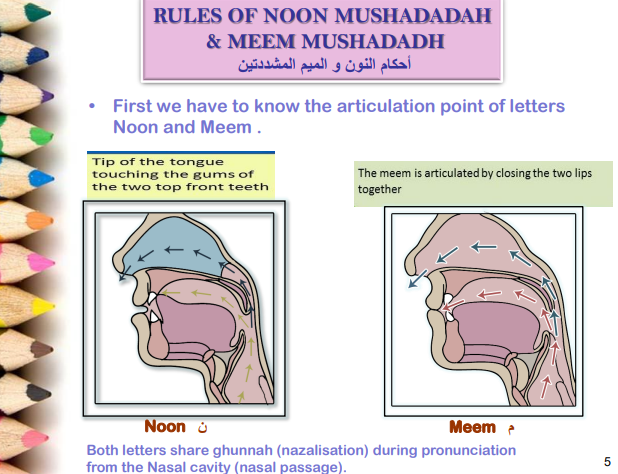
• The ghunnah is defined as a nasal sound that is emitted from the nose (nasal cavity) (AI-Khayshoom).
• Noon and Meem are called letters of ghunnah
-This is a required characteristic of the Noon u and Meem
-The Ghunnah cannot be separated from these two letters and is an inherent part of their makeup.
Mechanism
The mechanism of pronouncing this Meem mushadadah:
• Close the lips together to pronounce the Meem and keep it closed as we making the Ghunnah (nasalization) from the nose.
The mechanism of pronouncing with Noon mushadadah:
- Keep the tongue in its articulation point and produce ghunnah for approximately two counts.
- Whenever the letter noon and meem have shaddah on them, they are held for a period of time with ghunnah.
- This type of ghunnah is called the most complete ghunnah u and it is the longest ghunnah.
WHAT SHOULD WE DO IF THE WORD STOPS WITH OR MUSHADADAH?
If the reader stops on a word ending with noon or meem mushadadah the ghunnah of noon or meem still have to be applied.
Rules Applied To Noon Saakinah & Tanween
Noon sakinah is noon free from any vowel without dammah, fatha, kasrah. It remains unchanged in its written form and as well as in pronunciation when continuing to read after it and when stopping on it. The noon sakinah have a sukoon on it or can be written with no vowel.
from the book
When Stopping:
the reader can stop on this madd at the end of this word (برءاء) four vowel counts with two causes required lengthening and lengthening with presented sukoon, may also stop with five vowel counts if the reader reads required madd five counts, Also may stop with six vowel counts this is for one reason if he reads lengthening with presented sukoon six counts.
It is forbidden to stop on this word using the present sukoon lengthening with two vowel counts. This is due to the rule of the stronger of the two lengthenings, since the required joined lengthening is stronger than the presented sukoon lengthening.
In this example (رءا ايديهم) the hamzah precedes a madd letter, indicating an exchange lengthening, This madd is at the end of the word, and the first letter of the next word is a hamzah, so the allowed separated lengthening is also using this same madd letter, which is an alif.
In this case, when continuing reading, and the allowed separated lengthening is employed, so this madd lengthened 4 or 5 counts (by the way of Ash-Shatibiyyah)
When stopping on the first word only the exchange lengthening is used, since the hamzah that begins the second word is not being read, and there is therefore no allowed separate lengthening is used.
In case of this ayah
ذَلِكَ الْكِتَبُ لَا رَيْبَ فِيهِ هُدًى لِلْمُتَّقِينَ
the weaker soft lengthening precedes the stronger presented sukoon lengthening, when stopping on both of them, the stronger should then be the same length or longer in length than the weaker.
Screenshot from the Book
To read more about the Tajweed Rules Part Two By Rania Habib book Click the download button below to get it for free
 Click for a Copy from Amazon
or
 PDF Direct Download
 READ THIS BOOK ONLINE
  Don’t Miss out any Book Click Join OpenMaktaba Telegram group