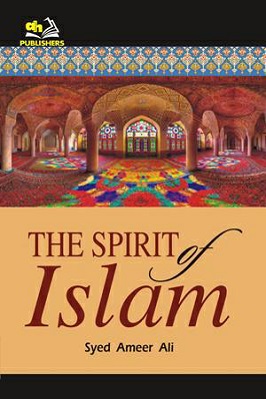
| Book Title | The Spirit Of Islam |
| Book Author | Ameer Ali Syed |
| Total Pages | 509 |
| Book Views | |
| Language | English |
| Book Download | PDF Direct Download Link |
| Get Hardcover | Click for Hard Similar Copy from Amazon |
The Spirit Of Islam Or the Life and Teachings of Mohammed by Ameer Ali Syed
THE SPIRIT OF ISLAM OR THE LIFE AND TEACHINGS OF MOHAMMED
Since the promulgation of Islam, the world has seen great changes; empires have risen and disappeared; great nationalization has been swept away making room for others; knowledge and culture have drifted from the East to the West; and with knowledge, not only power but material prosperity has changed hands.
Under the influence of their Prophet, a congeries of warring tribes consolidated into a nation, had for centuries carried aloft the torch of learning for the enlightenment of the world.
With the fall of their dominion, they ceased to be the preceptors of humanity. The younger nations who succeeded to their heritage continued some of their glory in arms but less in arts and literature. They too declined in power and influence, and now the greatest of them is but a shadow of its former self.
And yet as an active, living faith, Islam has lost none of its pristine force nor the magic hold it possesses over its followers. In certain parts of the world, it is spreading with greater rapidity than any other creed, and its acceptance among the less advanced races has invariably tended to raise them in the moral scale. As the study of comparative religion, like the study of comparative history, acquires importance in the estimation of scholars and students, the interest in Islam as a motive power in the world will deepen.
For outsiders, however, to understand its genius, and the causes of its unparalleled success in vitalizing humanity, and its vast potentiality for good, it is necessary to grasp its ” spirit,” and its aims and aspirations from a philosophical point of view; for the Islamist who desires to act up to the prescriptions of his religion, it is essential he should understand the significance of its ethics, the true meaning of its enunciations, and learn to differentiate between the permanent and the temporary.
It is only then that he can maintain his religion as it was intended to remain, an important lever, a valuable factor, for the progress and development of the world, and be himself in a position to keep pace with the growing ethical and social needs of a living and advancing community.
Nations like individuals, when they fail to realize the bent of the times and the necessities of the age, are doomed. And no one saw this more clearly or expressed it more forcibly than the Arabian Seer.
In the following pages, I have endeavored, however feebly and inefficiently, to portray the Islam of the Prophet and ” the Philosophersof his House,” and to give expression to their \ethical teachings and spiritual aspirations. Naturally, the consideration of Islamic ethics has involved criticism of the ethics of the earlier systems.
But it has not been done in a spirit of cavil or antagonism, nor does it imply the smallest want of respect for any other moral creed. I have deliberately opted for the English language for communicating my thoughts and views to Islamists as well as to others. English now exercises the same unchallenged sway over a greater part of the globe as Arabic did in Asia, Africa, and Spain for nearly seven centuries.
It is the language of culture and civilized progress. In India, it has become, within the last thirty years, the ordinary vehicle of literary thought. The Mahommedan subjects of this great Empire occupy a unique position in the history of our times.
Living under a Gmeonvetrnwhich pursues, so far as possible, a policy of strict religious matters while it is at the same time anxious to promote the moral and intellectual development of the people, they can, if they choose, avail themselves to the fullest extent of the progressive tendencies of the age without adjoining their faith or the prescriptions of their religion.
And by placing themselves in a line with the advancing ctioemmsuniof the West, they can sensibly influence other Mmaedhaomn communities which happen to be less favorably situated. For the last few centuries Islam has become, in the minds of a large number of its votaries, associated with a lifeless formalism ;
the practice of its rules of morality has given place to the mere profession, and its real aim as a creed to live by has been forgotten. For myself, I attach far more importance to moral vigor than to mental agility” to the character than to the faculty for passing examinations. I believe that the continued growth of a nation depends not on mere imitative intellectual cleverness but on the purity of its ethical standards.
And I consider that the first duty of those who wish to free their religion from the charge of obscurantism, bigotry or narrowness, is to endeavor to revive among the Moslems a knowledge of true Islamic ethics,” to elevate the general tone of thought, and to create a sense of patriotism and solidarity combined with a feeling of loyalty to the government under which they live.
In India we are in the throes of a great moral, social and intellectual revolution; the West is jostling the East, perhaps too vigorously at times, trying to awaken it from its lethargy, from its intense self-satisfaction and conceit in its old civilization.
Those, who would perhaps like to see the two retain their separate individualities, are apt to forget hat races, however remote in their modes of thought, must, by the very process of coming together, act and re-act on each other.
What is happening in India today happened ten centuries ago in the Iberian Peninsula. The learned author of ” Studies in History and Jurisprudence” has recently cpaomred British rule in India with the Roman provincial government.
He would probably find greater analogy in the Saracenic administration of Spain. It was equally liberal,sympathetic, non-exclusive and expansive; it gave the freest scope to local self-government ; it fostered trade and commerce ; encouraged agriculture and promoted education with eudnstint generosity; offices of trust and emolument were open
To read more about the The Spirit Of Islam book Click the download button below to get it for free
Report broken link
Support this Website
Click here to join our Telegram group for new Books